🚨On the road 2/16/2026: Traverse City, MI - Grand Rapids, MI - Lansing, MI 🚨
Get on route! Save on service!


Food Grade Magnet Certification




Annual On-Site Testing
We provide thorough on-site Pull Testing and Gauss Testing for magnets in food grade, animal feed & pet food industries to ensure safety, compliance and documentation. We test beyond industry minimums to ensure magnets are performing at their peak.
We work with leading industrial manufacturers to verify original magnet strength.
We work with food safety organizations to ensure that strength is compliant.
We are on the road frequently—contact us today to see when we will be in your area to save on mobilization costs! 24-hour quote guarantee!
PO's, ACH payment and Credit Cards accepted.




Food safety, or metal separation magnets require annual certification and validation. On-site magnet testing involves a qualified technician visiting your facility to assess the strength, condition, and effectiveness of your magnetic separation systems using calibrated equipment like gaussmeters or by performing NIST traceable pull tests. This process verifies that magnets meet performance standards, helps prevent accidents and breakdowns, ensures food safety by preventing metal contamination, and provides detailed reports and recommendations for maintenance, repair, or replacement.
💡Terminology (synonyms):
Food Grade Magnets.
Food Safety Magnets.
Tramp Metal Magnets.
Metal Separation Magnets.
Purpose of On-Site Magnet Testing
Food Safety: To ensure magnetic separators effectively capture metallic contaminants, preventing them from ending up in the final product.
Equipment Protection: To protect downstream machinery from damage caused by ferrous metal fragments.
Efficiency & Productivity: To confirm that magnetic systems are operating at peak performance, minimizing downtime and improving workflow.
Compliance & Documentation: To provide necessary documentation for food safety plans and other preventive controls, which can be required by auditors.
Methods Used
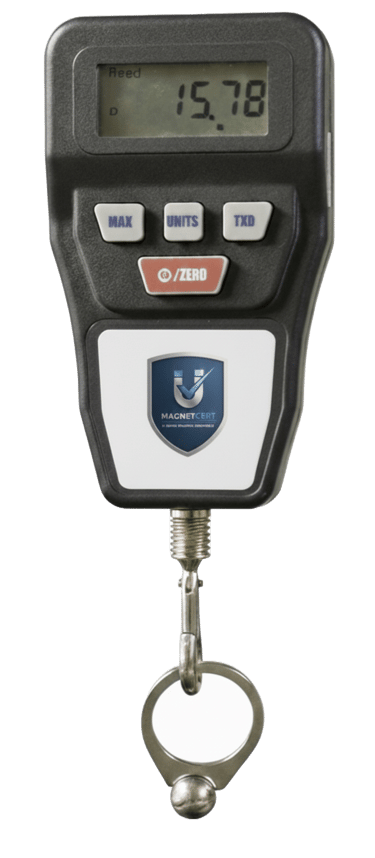
Pull Testing: Applying a force to pull a test piece away from the magnet, measuring the attractive force to determine strength.
The FDA requires minimum of 3 pulls per magnet. We sample well beyond industry minimums to create a clear picture of magnet strength.
NOTE: Customers often think "High Gauss = High Pull," but that isn't always true. While Gauss measures field intensity at a point, Pull Strength (Breakaway Force) measures the total mechanical holding power which is a better test of true capabilities of the magnet.
Gaussmeter Testing: Using a calibrated gaussmeter to measure the magnetic field strength.
Visual Inspection: Examining the condition of the magnet, case, leads, and other components for wear, corrosion, or damage.
Functional Test: Running the magnet through it's mechanical functions to ensure proper cleaning.
Minor adjustment and cleaning as needed.
Recommendations for full repair and PM.
What to Expect
Data Collection: Technicians will collect information on magnet type, location, and purpose.
Field Engineers: Qualified engineers will visit your site to conduct tests.
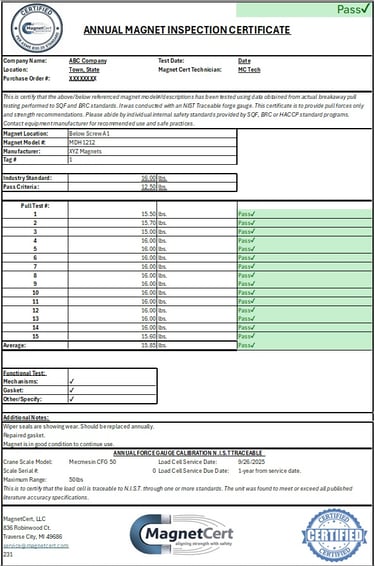
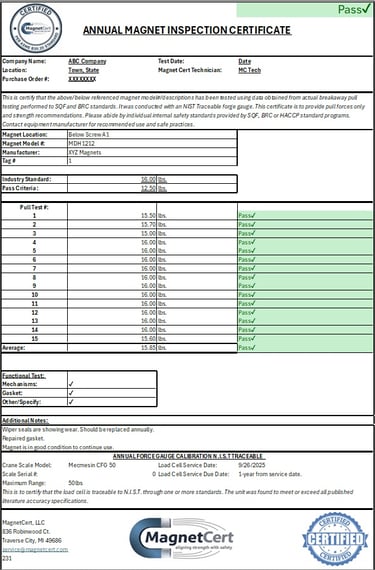
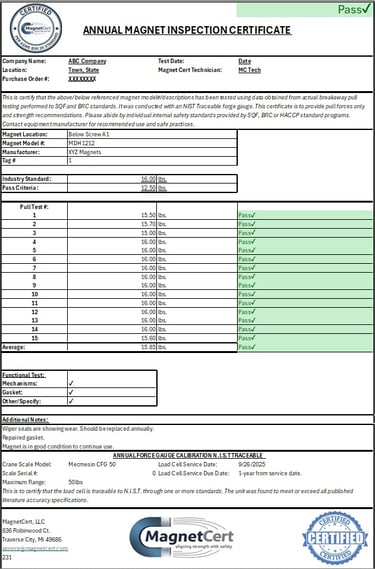
Detailed Reports: You will receive a formal report with test results, condition evaluations, recommendations, and a list of action items.
HACCP Support: Reports can be used as documentation to support HACCP-based food safety plans.
What we verify
✅ Magnet Integrity: Checking for pitting, cracks, or "Liquid Ingress" (where washdown water gets inside the magnet casing).
✅ Surface Gauss & Reach-Out: Measuring field intensity and ensuring the magnetic field extends deep enough into the product flow.
✅ Pull Strength (Validation): Using NIST-traceable equipment to perform the "0.5-inch Ball Pull Test" or "1-inch Plate Test" as per industry standards.
✅ Sanitary Design: Verifying that welds and surfaces meet food-grade requirements to prevent bacterial growth.
Benefits
Informed Decisions: Provides data to make informed decisions about magnet maintenance and replacement.
Reduced Costs: Helps minimize repair costs by identifying issues early.
Improved Safety: Identifies potential hazards and ensures magnets are functioning safely.
💡Did you know? In food production, Verification is the annual pull test we perform, while Validation is the proof that your magnet is actually capable of catching the specific metal hazards in your product stream. We help you satisfy both.
Industries served:
Flour Milling
Sugar production and processing
Pet food
Animal feed
Grain
Baking
Dairy
Pharmaceuticals
Plastics
All human consumption.
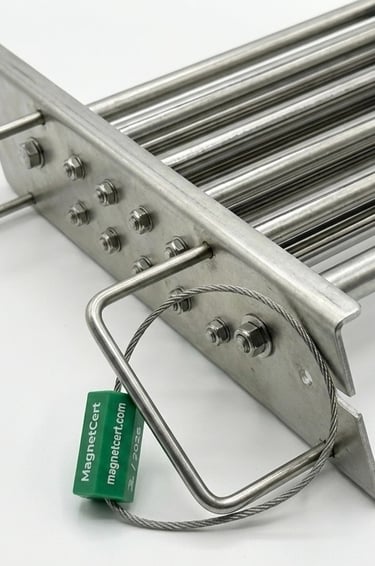
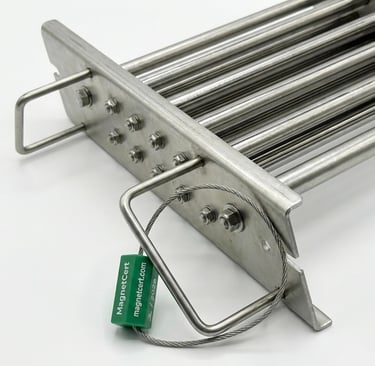
Annual Onsite Testing
Human Consumption, Animal Consumption and Pharmaceutical Grade Testing








💡Advanced Tramp Metal Analysis
While periodic testing is essential, a single failing magnet can indicate a larger systemic risk. Our Tramp Metal Separation Consulting goes a step further by evaluating your entire process flow. We don’t just tell you if a magnet is weak; we help you understand why and provide a roadmap for remediation.
Our expanded food-grade services include:
Performance Audits: Identifying underperforming magnets that threaten your compliance.
Strategic Placement: Engineering recommendations for new magnet installations at critical control points.
HACCP Alignment: Expert guidance on integrating magnet validation into your food safety plans.
Why Independent 3rd-Party Certification Matters:
While many facilities attempt to perform in-house magnet testing, an independent audit from MagnetCert provides three critical advantages that internal checks cannot:
Unbiased Objectivity: Auditors (SQF, BRC, OSHA) prioritize reports from external specialists. It eliminates the "conflict of interest" and proves your facility is held to the highest external standards.
NIST-Traceable Equipment: We use precision-calibrated Gauss meters and pull-test kits. Our tools are certified and traceable, ensuring your data holds up under the strictest regulatory scrutiny.
Audit-Ready Documentation: We don't just "test" magnets; we provide the professional certification paperwork that becomes a permanent part of your safety or quality manual. When the auditor asks for proof, you simply hand them the MagnetCert report.
Closing the Gap on HACCP Compliance: An auditor doesn't just want to see a number; they want to see a trend. Our Food Grade Certification provides the historical data required by SQF and BRC standards to prove your magnets haven't degraded over time due to heat or mechanical shock.
✅"The Audit Survival Checklist"✅
Is Your Facility Truly "Audit-Ready"? (The Magnet Safety Checklist)
Whether you are moving steel or processing flour, your magnets are your "silent guardians." But when was the last time they were truly verified? Use this quick checklist to see if you're prepared for your next inspection:
✅ The Paper Trail: Do you have a certificate for every magnet on the floor dated within the last 12 months?
✅ Calibration Proof: Can you prove the equipment used to test your magnets was itself calibrated and certified?
✅ Standard Compliance: Are your Food Grade magnets tested to SQF and BRC standards, or are you just "guessing" their breakaway strength?
✅ Physical Integrity: Have you checked for "dead spots," housing cracks, or weld fatigue that a simple visual check might miss?
✅ Third-Party Validation: If an auditor asks why you believe your magnets are safe, is your answer "because we checked them ourselves" or "because they were certified by MagnetCert"?
What we verify:
✅ Magnet Integrity: Checking for pitting, cracks, or "Liquid Ingress" (where washdown water gets inside the magnet casing).
✅ Surface Gauss & Reach-Out: Measuring field intensity and ensuring the magnetic field extends deep enough into the product flow.
✅ Pull Strength (Validation): Using NIST-traceable equipment to perform the "0.5-inch Ball Pull Test" or "1-inch Plate Test" as per industry standards.
✅ Sanitary Design: Verifying that welds and surfaces meet food-grade requirements to prevent bacterial growth.
Don’t leave your compliance to chance. Aligning Strength with Safety!®
The 3rd Party Advantage


Get in Touch
Speak with an expert about how we can help you.
Frequently Asked Questions
What is food grade magnet testing?
Food grade magnet testing ensures that magnets used in food processing meet strength and quality standards.
Why is on-site testing important?
On-site testing allows for immediate assessment and compliance with industry regulations like FSMA, HACCP and SQF. Certification keeps you aligned with Food Safety Auditors.
What standards do you follow?
We adhere to FSMA, SQF, HACCP and BRC standards to ensure the highest safety and quality in food processing.
Click here to fill out our comprehensive form.
Do you provide training?
Yes, we offer training sessions on food safety and magnet testing procedures. We can help you integrate the magnets into your HACCP plan. Educating your staff on magnets and our testing procedures comes standard.
What is your testing process?
Our testing process includes thorough inspections of magnet health. Pull and/or Gauss testing to ensure adequate magnet strength for compliance with food safety regulations.

Contact
Get in touch for magnet testing services.
Service:
Phone: 231-493-7934 Call or Text
© 2026 MagnetCert all rights reserved.



18+ Years Industry Experience
PO's, ACH payment and Credit Cards accepted.