🚨On the road 2/16/2026: Traverse City, MI - Grand Rapids, MI - Lansing, MI 🚨
Get on route! Save on service!

💡Consulting Services💡
SQF, BRC & HACCP
Tramp Metal Separation Consulting
Comprehensive Food Safety & Magnet Strategy
In the food processing industry, "good enough" isn't an option. Underperforming magnetic separators lead to product recalls, equipment damage, and audit failures. MagnetCert’s consulting services provide the technical expertise needed to optimize your metal fragment control program.
Our Consulting Pillars
Magnet Performance & Gap Analysis We perform a deep-dive audit of your existing inventory. By analyzing pull-strength trends and physical condition, we identify magnets that are no longer fit for purpose and provide specific recommendations for high-efficiency replacements.
Process Flow & Installation Strategy Is your metal protection in the right place? We analyze your production line to identify "blind spots" where tramp metal could enter or migrate. We provide a detailed map for new installation points to ensure maximum capture rates.
HACCP & Regulatory Integration We help bridge the gap between maintenance and quality assurance. Our team assists in integrating magnet validation protocols into your HACCP or HARPC plans, ensuring you stay compliant with GFSI, SQF, and BRCGS standards.
Internal Awareness Training We provide your team with the knowledge to identify magnet degradation and understand the importance of tramp metal separation, fostering a culture of food safety from the floor up.
Why Partner with MagnetCert?
We combine technical measurement with industry-specific safety standards. Our goal is to move your facility from reactive maintenance to a proactive contamination prevention strategy.
What Our Consulting Covers
1. Gap Analysis & Hardware Audit
We don’t just test; we investigate. Our audit identifies "silent failures"—magnets that may meet a minimum pull-test requirement but are incorrectly spec’d for the flow rate, product density, or temperature of your line.
Replacement Roadmaps: Prioritized lists of underperforming equipment.
Spec Optimization: Recommendations for Gauss strength and magnet material (e.g., Neodymium vs. Ferrite) based on your specific contaminants.
2. Strategic Installation Mapping
Adding more magnets isn't always the answer—placing them at Critical Control Points (CCPs) is. We analyze your facility's "Path of Contamination" to determine:
Incoming raw material screening points.
Protection for high-value downstream equipment (grinders, extruders, etc.).
Final stage "last line of defense" placement before packaging.
3. HACCP & Audit Readiness
We align your magnet maintenance with global food safety standards (SQF, BRCGS, FSSC 22000).
Documentation: We help you establish "Standard Operating Procedures" (SOPs) for magnet cleaning and inspection.
Risk Assessment: Formalized reporting that proves to auditors you have a validated system for tramp metal control.
Inside the MagnetCert Audit Report
Transparency is key. When we consult for your facility, you receive a comprehensive digital report including:
Asset Inventory: A serialized list of every magnet on-site with photos and location tags.
Performance Delta: Analysis of current pull-strength vs. original factory specs or safety requirements.
Zone-Based Risk: A "Heat Map" of your facility showing areas with the highest risk of metal entry.
Action Plan: A "High/Medium/Low" priority list for replacements and new installations.
Validation Summary: A signed certificate of compliance for your HACCP records.
"A single metal contamination event can cost millions in recalls and brand damage. Our consulting is designed to catch the fragment before it reaches the consumer."
How to Get Started
Site Discovery: A brief call to discuss your current production volume and existing magnet count.
On-Site Analysis: Our specialists visit your facility to conduct testing and flow analysis.
Strategic Delivery: You receive a full consulting report and a debriefing with your Quality Assurance team.
🚨 Red Flags: Is Your Facility at Risk?
If your facility matches any of the following, your metal separation strategy may be compromised.
🔴 Aging Magnet Inventory Magnets lose strength over time due to mechanical shock, heat (especially in washdowns), and moisture. If your magnets are over 3 years old without a professional recalibration, they may be "blind" to small fragments.
🔴 "Pass/Fail" Only Mentality Simply knowing a magnet "sticks" isn't enough. Without tracking Gauss degradation trends, you won't know a magnet is failing until it’s already let a contaminant through.
🔴 Improper Magnet Selection Using a standard magnet for high-viscosity liquids or high-velocity dry flows. If the magnet isn't spec’d for the flow rate, metal can be "washed off" the surface and back into the product.
🔴 Missing HACCP Documentation If an auditor asks for the validation logic behind your magnet placement and you don't have a documented risk assessment, you are at risk for a major non-conformance.
🔴 Collection Without Analysis Finding metal on a magnet is good; not knowing where it came from is a problem. We help you analyze "tramp metal finds" to identify failing machinery upstream.
🔴 Access Issues If a magnet is hard to reach, it won't be cleaned. If it isn't cleaned, it won't capture metal. We identify "ergonomic failures" in your installation.


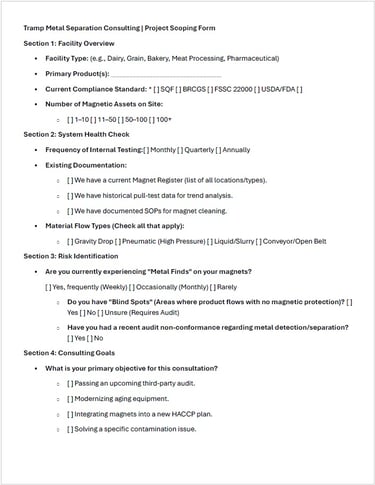
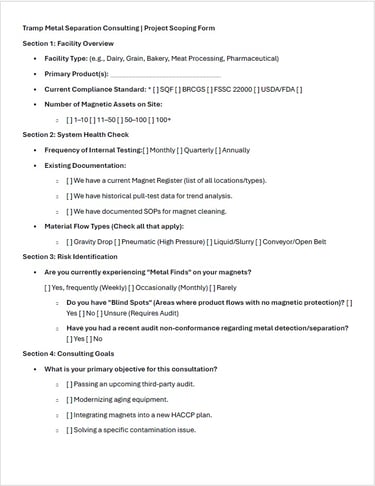

Contact
Get in touch for magnet testing services.
Service:
Phone: 231-493-7934 Call or Text
© 2026 MagnetCert all rights reserved.



18+ Years Industry Experience
PO's, ACH payment and Credit Cards accepted.