🚨On the road 2/16/2026: Traverse City, MI - Grand Rapids, MI - Lansing, MI 🚨
Get on route! Save on service!
About Food Safety Standards
Navigating the world of food safety can feel complex, but it's essential for protecting public health and your brand's integrity. While local regulations are important, many businesses benefit from implementing globally recognized standards. This approach not only ensures a high level of safety but also opens doors to new markets and partnerships. From the foundational principles of HACCP to comprehensive certification schemes like SQF and BRCGS, a layered approach to food safety can provide a robust and verifiable system that inspires consumer confidence.
🛡️ HACCP and FSMA: The Foundation and the Law
At the core of many modern food safety systems is HACCP, or Hazard Analysis and Critical Control Points. HACCP is a systematic, science-based approach to identifying and controlling hazards—biological, chemical, and physical—at every stage of the food production process. This proactive method focuses on prevention rather than reacting to contamination after it happens. While HACCP is a set of principles, the Food Safety Modernization Act (FSMA) is a U.S. federal law that mandates a preventative approach to food safety. FSMA shifts the focus of the FDA from responding to outbreaks to preventing them in the first place, requiring food facilities to have a comprehensive written food safety plan based on risk assessment. Essentially, FSMA provides the legal framework that makes a preventative system like HACCP a requirement for many food producers in the U.S.
🌐 Global Standards: SQF and BRCGS
To go beyond legal requirements and demonstrate a commitment to excellence, many companies pursue certification from global food safety schemes. Two of the most widely recognized are SQF (Safe Quality Food) and BRCGS (British Retail Consortium Global Standards). Both are benchmarked by the Global Food Safety Initiative (GFSI), an organization that helps ensure the credibility of food safety certification schemes. SQF is a comprehensive, HACCP-based system that covers both food safety and quality, providing a unique "quality code" that can be certified. This makes it a strong choice for businesses looking to verify both safety and overall product quality. BRCGS, on the other hand, is a well-established and widely accepted standard, especially in the European retail sector, that also incorporates HACCP principles and emphasizes senior management commitment and continuous improvement. Adopting one of these standards shows your partners and customers that your business operates at a globally recognized level of safety and quality, which can significantly enhance your reputation and market reach.
🌐 SQF stands for Safe Quality Food, referring to a global food safety and quality standard and certification program for food producers, manufacturers, distributors, and retailers. The certification demonstrates a company's commitment to rigorous food safety standards, encompassing aspects from primary production to food service, and helps them meet regulatory and retailer requirements.
Ensures Food Safety and Quality: The SQF program uses a systematic approach to manage and minimize potential physical, chemical, and biological hazards in food production.
Provides a "Farm to Fork" Approach: It covers the entire food supply chain, from the farm to the consumer, ensuring safety and quality throughout.
International Recognition: SQF certification is benchmarked by the Global Food Safety Initiative (GFSI), making it widely accepted by international buyers and regulatory bodies.
Mandatory for Many Suppliers: Many major retailers and distributors require suppliers to be SQF certified as a prerequisite for business.
How a business becomes SQF certified:
Education: Research and learn about the SQF Code and its requirements.
Implementation: Develop and implement an SQF management system within the facility.
Auditing: Pass an audit conducted by an approved certification body to verify compliance with the SQF Code.
Certification: Obtain the certification after passing the audit and implementing any necessary corrective actions.
Renewal: Undergo annual surveillance or recertification audits to maintain the certification.
🌐 BRC (BRCGS) stands for the British Retail Consortium (Global Standard), which developed the BRCGS Global Standard for Food Safety. This internationally recognized standard provides a framework for assessing and certifying food manufacturers, suppliers, and other businesses to ensure they meet stringent requirements for food safety, quality, and legality. Achieving BRC certification demonstrates a company's commitment to global food safety standards, enhances consumer trust, and opens doors to new markets, making it a crucial benchmark for competitive businesses worldwide.
Sets a Globally Recognized Standard: The BRCGS Global Standard for Food Safety is a widely accepted benchmark for food safety and quality, recognized by major retailers and brand owners globally.
Ensures Product Safety and Quality: The standard ensures companies implement rigorous food safety management systems and meet high standards of quality, legality, and operational practice.
Facilitates Audits: Companies undergo a BRC audit by independent auditors who assess how well their food safety management system meets the BRC standard's criteria.
Focuses on Food Safety Culture: The standard includes requirements for promoting and maintaining a strong food safety culture within an organization.
Why It's Important for Food Businesses
Builds Consumer Trust: A BRC certification assures consumers that the products they are buying meet high safety and quality standards.
Increases Competitiveness: It strengthens a brand's reputation and helps food businesses remain competitive in both local and international markets.
Reduces Audits: Retailers and customers often accept a BRC certification as sufficient proof of compliance, reducing the need for multiple customer audits.
Streamlines Operations: Implementing BRC standards can improve operational efficiency and minimize risks across food safety processes.

Food Safety Standards FAQ
What is FSMA?
FSMA stands for the Food Safety Modernization Act, focusing on preventing food safety issues.
What is HACCP?
HACCP stands for Hazard Analysis Critical Control Point, a systematic approach to food safety.
What does SQF mean?
SQF stands for Safe Quality Food, a certification program ensuring food safety and quality standards are met.
What is BRC?
BRC stands for British Retail Consortium, a global standard for food safety compliance. BRC has rebranded to BRCGS and is a GFSI-benchmarked standard (Global Food Safety Initiative).
What is magnet testing?
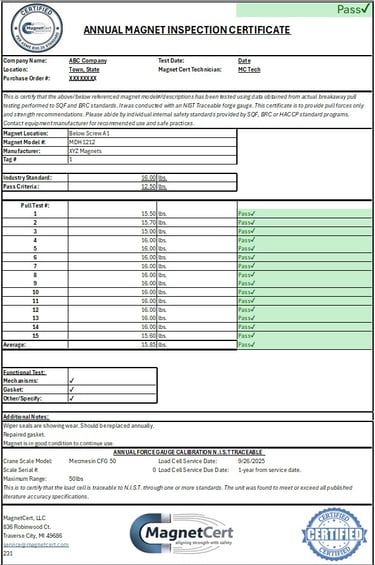
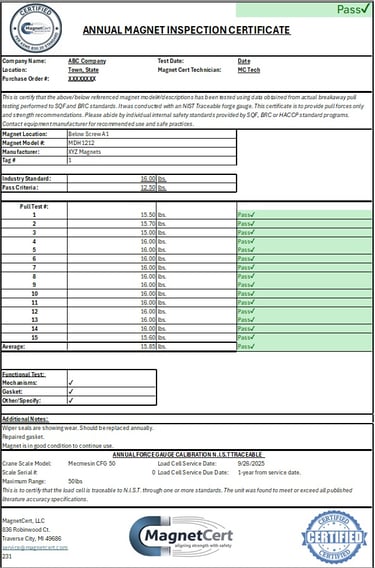
Pull testing and Gauss testing ensure magnet strength year-after-year. Annual testing is must to stay in compliance for food safety audits.
Why are these standards important?
These standards are crucial for ensuring food safety, protecting consumers, and maintaining industry integrity.
How can I contact you?
You can reach us through our Comprehensive Form by clicking here.

Contact
Get in touch for magnet testing services.
Service:
Phone: 231-493-7934 Call or Text
© 2026 MagnetCert all rights reserved.


18+ Years Industry Experience
PO's, ACH payment and Credit Cards accepted.