🚨On the road 2/16/2026: Traverse City, MI - Grand Rapids, MI - Lansing, MI 🚨
Get on route! Save on service!

The Ultimate Guide to Magnet Preventative Maintenance (Food & Lifting)
Is your maintenance routine actually protecting you? Learn the essential cleaning and inspection tips for food safety and lifting magnets to prevent failures and extend equipment life.
MagnetCert
1/1/20263 min read
Preventative Maintenance: Why a "Set It and Forget It" Mentality Fails with Industrial Magnets
Whether you are protecting a food production line from metal fragments or lifting 5,000-lb steel plates, your magnets are only as good as your maintenance routine. While magnets don't have engines or gears, they are not "zero-maintenance" tools.
In fact, the difference between a magnet that lasts 20 years and one that fails in two often comes down to two simple things: Cleaning and Inspection.
Food Safety: The Danger of the "Full" Magnet
In food processing, a magnet’s job is to capture "tramp metal." But here is the catch: A magnet covered in metal is no longer a magnet; it’s a bypass.
The Saturation Point: As metal debris collects on the surface of a magnetic grate or trap, it creates a "shield." New metal fragments hitting that debris won't stick; they will simply bounce off and continue into your final product.
The Solution: A regimented cleaning schedule is the only way to ensure 100% effectiveness.
Surface Monitoring: Beyond cleaning, operators must check for pitting or wear on the stainless steel tubing. A tiny crack can let moisture in, leading to internal corrosion that ruins the magnet from the inside out.
How MagnetCert Helps: During our visits, we don't just test; we optimize. We help you adjust your cleaning mechanisms and train your staff on the "tips and tricks" of effective cleaning, ensuring your team knows exactly what to watch for between our visits.
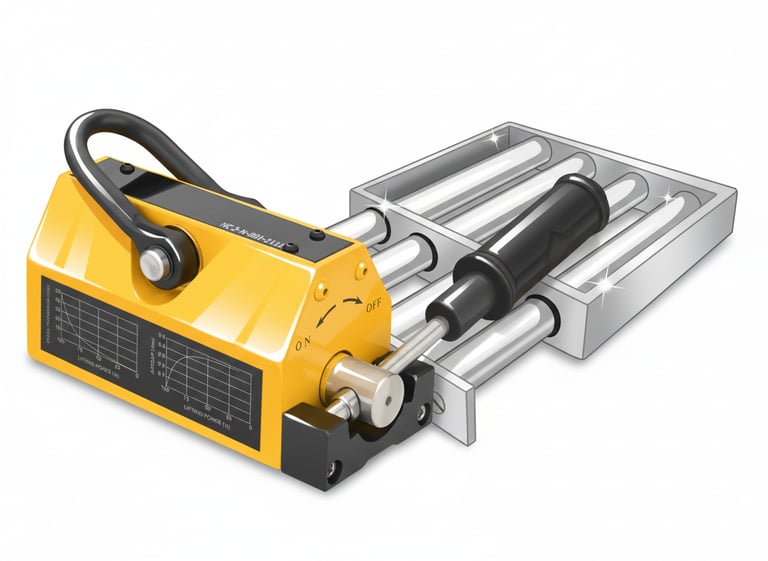
Permanent Lifting Magnets: The Power is in the Contact
For lifting magnets, safety is entirely dependent on the Surface Gap. Anything—even a thin layer of dust—between the magnet and the workpiece reduces lifting capacity.
Clean the Face, Clean the Load: Before every lift, both the magnet face and the workpiece surface must be wiped clean. Small burrs, scale, or dirt create an air gap that can dangerously reduce the 3:1 safety factor.
Mechanical PM: Most permanent lifting magnets are incredibly simple to maintain. Often, keeping the mechanism smooth and safe is as easy as tightening a few screws and ensuring the handle engages fully.
Surface Check: Look for pits, cracks, or "mushrooming" on the magnet face. These deformities prevent a flush mount and are an immediate red flag for safety.
How MagnetCert Helps: We believe in "Maintenance through Education." While we perform your annual certification, we offer basic on-site training for your operators, showing them how to perform daily checks and proper storage techniques to keep your equipment in peak condition.
1. The "Daily 5" Pre-Shift Checklist
Surface Integrity: Check for chips, gouges, or "mushrooming" on the lifting face.
Handle Engagement: Does the lever lock firmly into place?
Safety Latch: Is the manual lock pin or safety latch spring-loaded and functional?
Cleanliness: Is the face free of oil, grease, or metal shavings? (Essential for that 3:1 breakaway force).
Labeling: Is the capacity tag actually readable, or has it been scraped off?
2. The Relationship Between PM and the 3:1 Safety Factor
Explain why maintenance matters for physics.
Air Gaps: Explain that even a 0.005" layer of paint, rust, or a small dent creates an "air gap" that can slash a magnet's lifting power by 50% or more.
Testing: Remind them that preventative maintenance is what ensures they pass their annual breakaway test.
3. Service Classes (Normal vs. Heavy vs. Severe)
Break down how often they should be doing deep-dive inspections based on their environment:
Normal: 1 shift/day (Annual deep inspection).
Heavy: 2-3 shifts/day (Semi-annual deep inspection).
Severe: Harsh environments/constant cycling (Quarterly deep inspection).
4. Professional Testing vs. Visual Inspection
Clarify that while their team does the daily PM, the ASME B30.20-2025 standard still requires periodic documented testing by a "qualified person" (which is where MagnetCert comes in).
Invest in Longevity, Not Just Compliance.
Preventative maintenance doesn't just pass audits—it saves lives and prevents recalls. If your team could benefit from a "refresh" on magnet care, we are here to help.

Contact
Get in touch for magnet testing services.
Service:
Phone: 231-493-7934 Call or Text
© 2026 MagnetCert all rights reserved.



18+ Years Industry Experience
PO's, ACH payment and Credit Cards accepted.